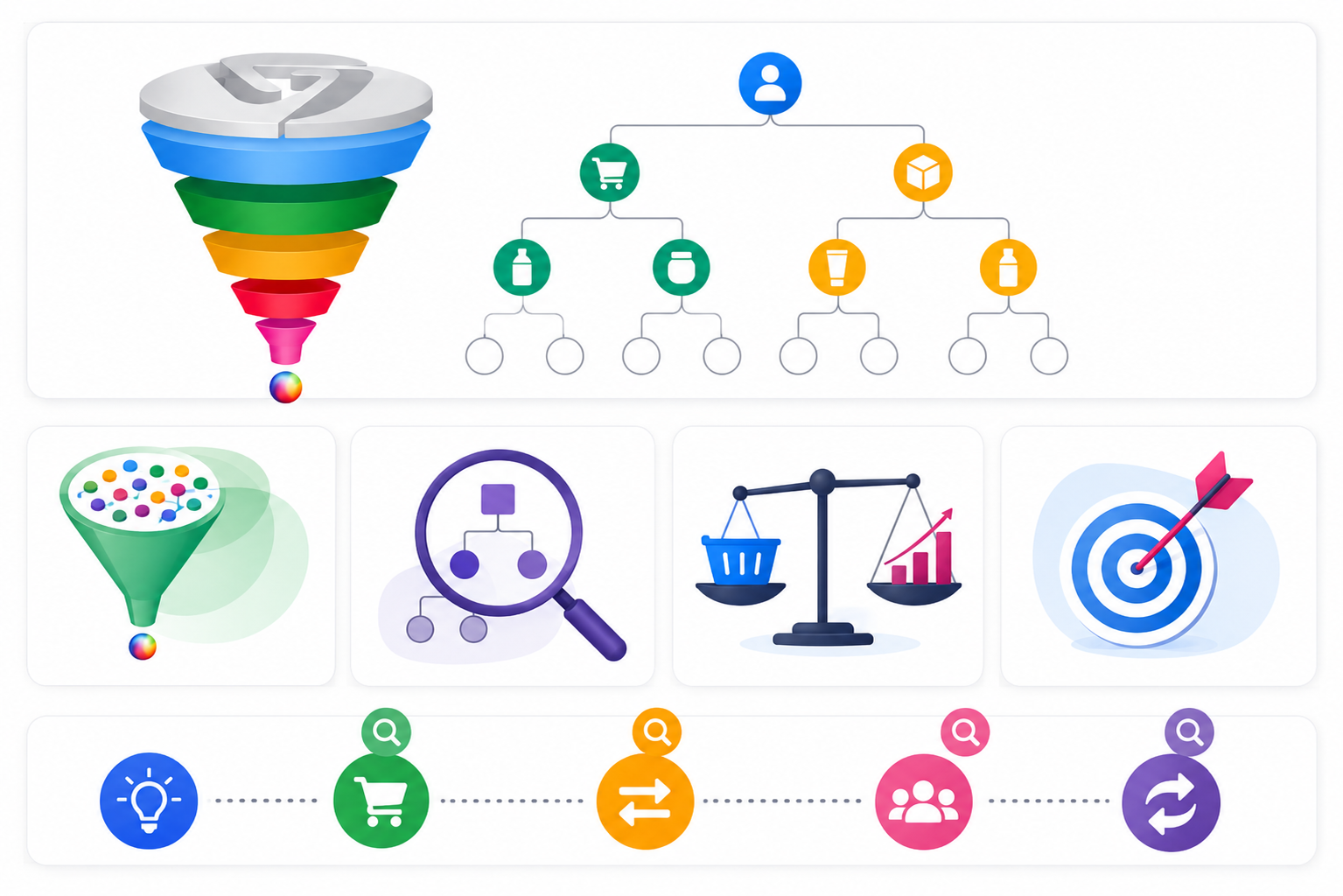
Decision Trees can be an incredibly powerful tool to inform shelving and merchandising principles. Unlocking their true value requires you to zoom out and see the big picture.
A Decision Tree is not a shelf in and of itself. It is one critical piece of an analytic framework to help us influence the moment of choice at the shelf.
Maximizing the value of a Decision Tree requires several considerations:
First, not all Decision Trees are created equal. There are many names (Consumer Decision Tree, Market Structure, Decision Hierarchy, Category Decision Tree, etc.), often used interchangeably, and even more methodologies used to create the trees.
It is important to understand what your Decision Tree is conveying. Some denote what is most top of mind for shoppers as they navigate the category; some signify what products are substitutable; some imply associations based on co-purchasing within a household; some suggest what is most important to shoppers when making a selection. Do you know what yours is?
Ultimately, we believe the goals of successful merchandising principles are to:
Make it easy for shoppers to find what they want. We know that when the shopping experience is fast and easy, shoppers are more likely to purchase and to build a bigger basket.
Make it easy for shoppers to find what they want... while at the same time framing choice to advance your own strategies (yours and your retailers’). There has to be a balance. The manufacturer and the retailer need to be successful, or we won’t have jobs.
How can a good Decision Tree framework help satisfy shoppers while also advancing manufacturer and retailer strategies?
Any successful solution MUST be guided in part by your brand strategies and your retailer’s strategy and objectives. Recommendations should reflect not only what shoppers want but also how you want to influence them.
With those strategies factored in, understand how shoppers navigate choices and the process they use to narrow those choices down to a consideration set. In other words, if you know what is most top of mind for the shopper when they reach the aisle (Brand? Form? Size? etc.), make it easy to find that.
Determine what product attributes or characteristics are directly substitutable. Product types that are less interchangeable tend to perform best when separated from each other.
Uncover what need states or jobs different types of products within a category fulfill. Logical adjacencies can be informed by knowing what products meet similar needs.
Be adaptable. There are nuances by channel and by retailer, so don’t simply develop one best-in-class planogram that is expected to work across the entire retail landscape.
Ultimately, there is some art that goes into the science of building merchandising and assortment principles. If you are simply translating your Decision Tree into a shelf, you are missing the big picture.
Where Vista Grande Fits In
This is where we focus. We take foundational tools like Decision Trees and extend them into real-world strategy—connecting shopper logic to how decisions actually happen in-store.
That means:
- Translating insight into visibility
- Turning structure into intuitive navigation
- Aligning shopper behavior with brand growth
- Designing solutions that work in reality, not just in theory
Because understanding decisions is one thing, designing for them is another.
Taking Your Merchandising and Assortment Further
At Vista Grande, we help brands move beyond simply understanding shopper behavior to actively shaping it—developing strategies that win where it matters most: at the shelf.
Because growth isn’t driven by insight alone, it comes from applying that insight in ways that make it easier to shop, choose, and win in the moment of decision.
That’s the difference between using a Decision Tree and using it to its full potential, influencing the moments of choice.
If you would like more information, email us at info@vistagrandestrategy.com.